 STITCH ROUND
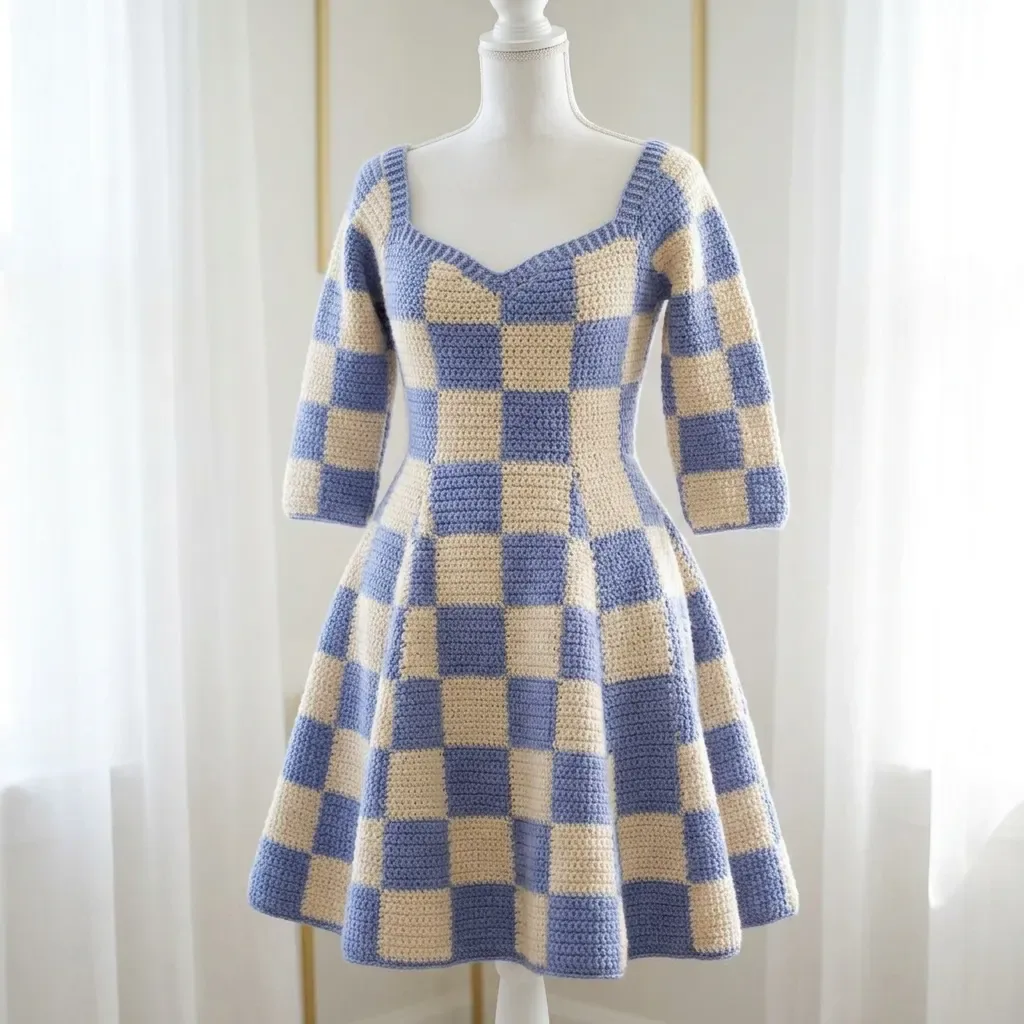
 Checkerboard crochet dress in periwinkle and cream
19 rounds build the bodice front of this checkered periwinkle dress with sweetheart shaping.
- Skill
- Intermediate
- Rounds
- 18 rounds
- Yarn weight
- Worsted
- Hook
- 6.0 mm
- Time
- 4-6 hours
Intermediate
What the original page called it. Nothing here is graded a second time.

18 rounds
Each one gets its own line, with a box beside it to tick as you go.
Worsted
What the sample was made in. Any weight works — the size moves with it.
About this pattern
The bodice front is 19 rounds of two-color single crochet, worked in a checkerboard grid that shifts every few rows to build alternating tiers. Two strands of worsted weight yarn get carried side by side throughout, so each round is really two small jobs: keep the sc count honest and keep the color blocks square. Ticking off a full tier at a time makes the piece easier to track than counting single rows.
Waist shaping starts once the checkerboard tiers are established, and the side stitches decrease while the block pattern keeps running underneath. This is where the color changes get fussy, since the outer blocks shrink below their usual width and both yarns still need to land in the right spot at the edge. Slow down at every decrease round and check the block color before working the next stitch, not after.
- Chain the foundation row in Color A and set up the first checkerboard tier across the row.
- Work several rows straight in the established color blocks before shifting to the next tier.
- Repeat the block-shift rows to stack horizontal checkerboard tiers up the bodice front.
- Move into waist shaping, decreasing at the sides while keeping the checkerboard blocks aligned.
- Work the skirt flat from the waist down, then seam the short ends into a tube.
- Finish the opening with single crochet ribbing, seaming its ends and sewing it in place.
What goes wrong
- Losing track of the checkerboard tier Place a stitch marker at the start of each new tier so the block-shift rows are easy to find again after a break.
- Tangling the two carried yarns Keep Color A and Color B on opposite sides of the work as they travel up, and untwist them every few rows.
- Letting edge blocks drift off-color during shaping Check the color of the stitch before working it whenever a block narrows below its full width at the sides, since decreases can shift where a block starts.
- Seaming before blocking Wet block both pieces flat first so the checkerboard squares match at the seam line, then join with mattress stitch.
Yarn, hook and the rest
Copied from the source pattern's own materials list.
- Lion Brand Yarn Pound of Love (100% acrylic, worsted weight, 1,020 yards per 16 oz skein) gives excellent stitch definition for the checkerboard. It’s machine washable, affordable, and available in suitable blue and cream shades.
- Paintbox Yarns Simply DK held double (100% acrylic, DK weight) brings the weight to worsted when you hold two strands together. The matte finish closely mimics the texture in the finished dress.
- Cascade 220 (100% Peruvian Highland Wool, worsted weight, 220 yards per 100 g skein) blocks beautifully for a polished finish. You’ll need 4 (4, 5) skeins of each color. Note that this yarn is not machine washable.
Substitution tip
- Choose a yarn with good stitch definition and minimal halo or fuzz. Avoid fuzzy or highly textured yarns since they’ll obscure the color blocks. Always purchase one extra skein of each color to account for colorwork carry yarn consumption.
Yarn
- Worsted weight, Category 4, approximately 1,400 (1,600, 1,800) yards total
- Color A (Periwinkle Blue): 700 (800, 900) yards
- Color B (Cream): 700 (800, 900) yards
Hook
- US Size J / 6.0 mm
Notions
- Yarn needle for seaming and weaving ends
- Stitch markers (at least 6)
- Measuring tape
- Scissors
- Blocking mats and pins
Optional
- dress form or mannequin for fitting during construction
Progress tracker
0 of the 18 rounds on this page are ticked.
The pattern, round by round
Kept in the order and the wording the source used. Tick a round as you finish it; the ticks stay on this device.
Bodice Front
Foundation: Using CA, chain 82 (90, 98).
Round 1
(RS): Sc in 2nd ch from hook and in each ch across. Change colors every 8 sts following checkerboard arrangement. Begin with CA for sts 1-8, CB for sts 9-16, CA for sts 17-24, CB for sts 25-32, CA for sts 33-40, CB for sts 41-48, CA for sts 49-56, CB for sts 57-64, CA for sts 65-72, CB for sts 73-80. Ch 1, turn. (80 sc) [M: 88 sc, L: 96 sc]
Rounds 2–8
Continue in established checkerboard pattern, maintaining color blocks in same positions. Ch 1, turn at end of each row. (80 sc each row) [M: 88, L: 96]
Round 9
Begin new horizontal checkerboard tier. Shift all color blocks: sts 1-8 now worked in CB, sts 9-16 in CA, continuing in alternating pattern opposite to rows 1-8. Ch 1, turn. (80 sc) [M: 88, L: 96]
Rounds 10–16
Continue new checkerboard arrangement. Ch 1, turn. (80 sc each row) [M: 88, L: 96]
Rounds 17–24
Repeat rows 1-8 arrangement (back to original block positions). Ch 1, turn. (80 sc each row) [M: 88, L: 96]Checkpoint: After Row 24, the bodice front should measure approximately 5 in / 12.5 cm tall and 17.75 in / 45 cm wide. You should see 3 complete horizontal checkerboard tiers.
Waist Shaping (Decrease Section)
Note on checkerboard during shaping: As side stitches are decreased, the outermost color block narrows. Continue carrying both yarns and work the remaining stitches of each block in the correct color even if blocks become less than 8 stitches at the edges.
Round 25
Sc2tog over sts 1-2, sc in each st to last 2 sts, sc2tog. Ch 1, turn. (78 sc) [M: 86, L: 94]
Round 26
Work even in pattern. (78 sc) [M: 86, L: 94]
Round 27
Sc2tog over sts 1-2, sc in each st to last 2 sts, sc2tog. Ch 1, turn. (76 sc) [M: 84, L: 92]
Round 28
Work even in pattern. (76 sc) [M: 84, L: 92]
Round 29
Sc2tog over sts 1-2, sc in each st to last 2 sts, sc2tog. Ch 1, turn. (74 sc) [M: 82, L: 90]
Round 30
Work even in pattern. (74 sc) [M: 82, L: 90]
Round 31
Sc2tog over sts 1-2, sc in each st to last 2 sts, sc2tog. Ch 1, turn. (72 sc) [M: 80, L: 88]
Round 32
Work even in pattern. (72 sc) [M: 80, L: 88]Checkpoint: After Row 32, the bodice front waist section should measure approximately 8 in / 20 cm tall. Width at narrowest point should be approximately 16 in / 40.5 cm for size S.
Hip and Bust Increase Section
Round 33
2 sc in first st, sc in each st to last st, 2 sc in last st. Ch 1, turn. (74 sc) [M: 82, L: 90]
Round 34
Work even. (74 sc) [M: 82, L: 90]
Round 35
2 sc in first st, sc in each st to last st, 2 sc in last st. Ch 1, turn. (76 sc) [M: 84, L: 92]
Round 36
Work even. (76 sc) [M: 84, L: 92]
Round 37
2 sc in first st, sc in each st to last st, 2 sc in last st. Ch 1, turn. (78 sc) [M: 86, L: 94]
Join
Step 1The skirt is worked flat from the waist down, then the short ends are seamed to form a tube.
Step 2Seaming is done using the mattress stitch with matching yarn for invisible joins on the RS.
Step 3Wet blocking the finished pieces before seaming allows checkerboard blocks to align precisely.
Step 4Single Crochet Ribbing finishing: continue ribbing for the length required, then seam short ends together and sew ribbing to opening.
Finish
- Weave in every color change end from the carried yarn before seaming, working each tail along the back of its own color block so it stays hidden.
- Wet block the bodice front and skirt pieces flat and let them dry fully so the checkerboard blocks line up square before any seam is sewn.
- Mattress stitch the skirt's short ends into a tube on the right side, then seam the ribbing ends and sew the ribbing to the opening.
Bigger or smaller
- Larger or smaller
- Repeat or omit a straight tier of the checkerboard pattern before starting the waist shaping to add or remove length in the bodice front.
FAQs
Asked and answered
These answers came from whoever first published the pattern, kept word for word.
Can this be made with just one color?
The checkerboard grid depends on Color A and Color B alternating in blocks, so a single-color version would lose the pattern entirely. Substituting a third color for either CA or CB works fine as long as the contrast stays clear.
Do the yarns need to be cut at every color change?
No, both Color A and Color B are carried up the work rather than cut, which keeps the back of the checkerboard tidy. This is the technique referred to as working with carried yarn throughout the pattern.
Why does the pattern suggest a swatch first?
Carrying two yarns through a shifting checkerboard takes practice to keep tension even, especially at the block-shift rows. A small swatch lets that rhythm get worked out before committing to the full bodice front.
What causes checkerboard blocks to look uneven after seaming?
Seaming unblocked pieces is the usual culprit, since the checkerboard squares can sit slightly askew until the fabric is wet blocked flat. Blocking both the bodice and skirt before joining lines the blocks up at the seam.